
Field Report
Quality Checkpoints for a Body Care Production Run
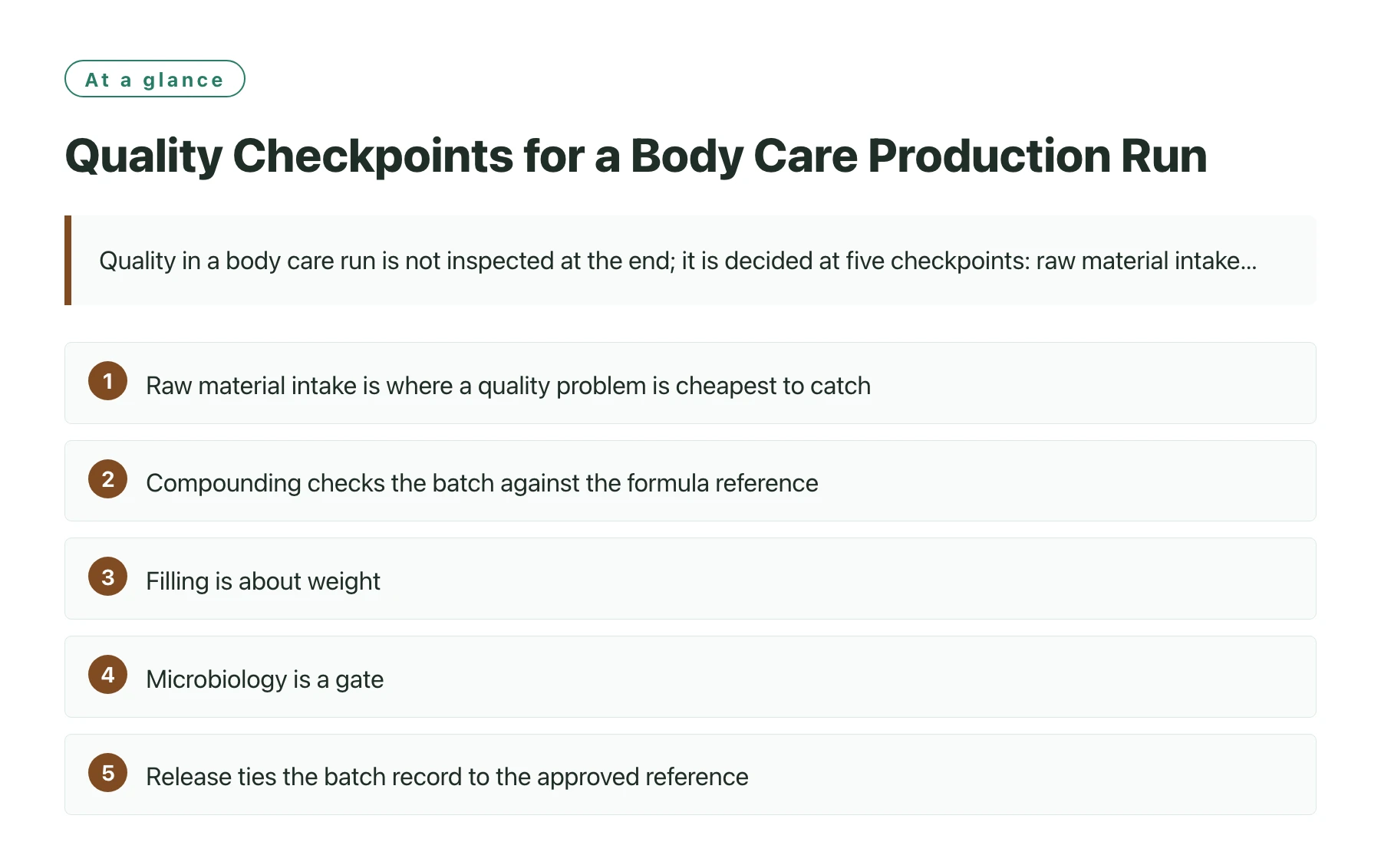
Quality in a body care run is not inspected at the end; it is decided at five checkpoints: raw material intake, compounding, filling, packing and release. Each checkpoint has one question and one record, and if the records line up, the product is repeatable. Most problems that surface in the market — separation, contamination, wrong fill — were visible at a checkpoint earlier. Audit the checkpoints, not just the finished bottle.
Key takeaways
- Raw material intake is where a quality problem is cheapest to catch, so materials should be released before they enter the line.
- Compounding checks the batch against the formula reference, including the fragrance oil's own lot and quantity.
- Filling is about weight, seal and headspace, and each is measurable on a sampled basis per line run.
- Microbiology is a gate, not a guess: the finished format is tested, and GMP-aligned laboratories make it routine.
- Release ties the batch record to the approved reference, which is what a retailer audit asks for.
A brand that visits a factory and smells the samples is performing quality theatre. The useful visit looks at the line, the retained references and the paperwork of a real batch.
This article maps the five checkpoints of a scented body care run, what each one verifies and which record it leaves behind.
The five checkpoints
| Checkpoint | What to verify | Which record it leaves |
|---|---|---|
| 1. Raw material intake | Identity, specification, expiry and lot of each material | Intake record with lot numbers |
| 2. Compounding | Formula match, fragrance oil lot and quantity, mix time and temperature | Batch manufacturing record |
| 3. Filling | Fill weight, seal integrity, headspace | In-line check sheets |
| 4. Packing and labelling | Artwork match, batch code, expiry and legal text | Packing record |
| 5. Release | Micro and stability status, retained reference match | Release certificate |
Read the third column: if every row has a record, the run is auditable.
What the laboratories do
Two of the checkpoints lean on outside laboratories. Microbiology and stability testing on the finished format are standard services from testing houses aligned with cosmetics GMP, which is what makes the release gate practical rather than heroic [1].
The fragrance layer has its own safety framework: the industry's safe-use science is the basis for the restrictions every compliant oil is built against, and it is worth knowing where that frame comes from [2].
Release documents matter at the end of every run, not only at the start of the relationship. Ask to see the release certificate for the batch you are buying, and check that the batch number on the record matches the batch number on the carton. That one consistency check catches more errors than any other single question.
Where buyers make the mistake
Checking the sample instead of the process
An approved sample proves the product can be made; it proves nothing about the run that fills thousands of units. The checkpoint records are the evidence for the run.
Skipping the intake gate
Most contamination and specification failures enter at the raw material door. A supplier that checks materials on arrival and rejects them at intake catches the problem at its cheapest moment.
Forgetting the retained reference
Without a sealed reference from the approved batch, 'match the sample' has no meaning. The release gate compares the run against the reference, so the reference has to exist first.
Not reading the release certificate
The release certificate is the last record and the most readable one, yet many buyers never look at it. It should name the batch, the reference it was released against and the tests it passed. If the certificate is vague about any of the three, the run was released on faith.
Making QC practical on a small line
A small order does not need a small quality system; it needs the same checkpoints with realistic sampling. The cheapest way to get there is to work with a maker whose baseline is public: certification and scope stated on Xuelei's website make the first audit faster, because you already know what you are checking against.
And the checkpoint logic transfers across categories: where testing sits in the process — before release, never after — is the same for scent-heavy products as for anything else safety testing in perfume manufacturing.
If this feels like a lot of process for a small brand, run the arithmetic the other way: each checkpoint is one question and one record, and the records double as your audit file. The same folder that satisfies your retailer is the folder your factory already keeps for its own release.
If you only audit the finished bottle, you are auditing the last ten minutes of a process that took ten weeks. Audit the checkpoints, and the bottle takes care of itself.
Sources
- SGS: Cosmetics, Personal Care & Household Testing —— Testing, inspection and certification services for cosmetics and personal care, including microbiological, stability and safety testing aligned with cosmetics GMP.
- IFRA: Safe Use and Fragrance Science —— IFRA's explanation of how fragrance materials are scientifically assessed for safe use and how those conclusions are applied by the industry.
Frequently asked questions
How many quality checkpoints should a small run have?
Five is a workable minimum: intake, compounding, filling, packing and release. Each one is one question and one record, so the list stays cheap even on a pilot order.
Who does the microbiology testing?
Either the factory's own laboratory or a third-party testing house; both routes are common. What matters is that the test covers the finished format and that the report is released to you.
What is a retained reference sample for?
It is the physical standard that production must match. Without a sealed, dated, batch-numbered reference, release becomes a judgement call and disputes become who-said-what.
Can I rely on the factory's own QC?
You can rely on its records once you have seen one full set and understood them. The first order is the audit: ask to walk through intake, compounding, filling, packing and release for the batch you are buying.
What should I audit on my first visit?
Three things the sales tour avoids: the intake area, one full batch record with the corresponding reference sample, and the release paperwork for a recent run. Ninety minutes of that is worth more than a day of smelling samples.
Get the Weekly Snow Report
One email every Thursday morning. Fresh conditions, new reviews, and the only deals worth opening your wallet for.