
Melamine Panels for Cabinets, Wardrobes and Wall Decor
Most melamine-faced panels spend their life where nobody photographs them: inside a wardrobe, behind a vanity door, under a shelf in an office fit-out. What decides whether they hold up there is a short list rather than a long one — two thicknesses, six surface finishes, four cores and one formaldehyde class. Dongstar publishes all of it on the same page as the panels, and every figure below is copied from those pages.

Key takeaways
- Two thicknesses do the volume: 16 mm and 18 mm, both on a 1220 × 2440 mm sheet.
- Six finishes are listed as separate products — Synchronized Texture, Glossy, High Glossy, Smooth, Matte and Embossed.
- The core under the face can be OSB, MDF, Particle board or Hardwood Plywood, so one decor sits on four different substrates.
- Glue and emission class are quoted apart: Urea Formaldehyde resin, with E0 and E1 among the formaldehyde classes offered.
Sixteen and eighteen millimetres carry the range
The published panel size is 1220 × 2440 mm, with further sizes listed beyond it, and the thickness list starts at 16 mm and 18 mm. Those two numbers are not arbitrary. Sixteen millimetres is the thickness the furniture trade designs carcases around — side panels, shelves, dividers and back rails. Eighteen millimetres is what doors, drawer fronts and any part carrying a hinge screw in its edge tend to use, because the extra two millimetres give the fitting more material to bite into.
Buyers who need another thickness can ask for it, since the page treats additional options as a normal request rather than a special project. What matters commercially is that the thickness reaches the purchase order as a number. A 16 mm carcase and an 18 mm door are not interchangeable once the fittings are drilled, and a delivery mixing the two is a cutting problem nobody wants on site. The sheets are pressed by Dongstar Group in Linyi city, Shandong, China, which is where the size and thickness conventions for this range are set.
Six surface finishes, six different jobs
The face types are named as Synchronized Texture, Glossy, High Glossy, Smooth, Matte and Embossed. Each behaves differently in a fitted room. A matte face hides the fine scratches that collect around handles and the fingerprints that follow a family down a hallway. A high glossy face does the opposite: it reflects light, shows every mark, and therefore tends to be specified for doors and wall decor rather than for a work surface wiped down twice a day.
Synchronized Texture is the finish that most often decides a specification. The relief in the surface is registered against the printed decor, so the grain a buyer sees is the grain a hand feels. That registration is what separates a convincing wood-effect panel from a flat print, and it is why specifiers ask for a physical sample instead of judging from a screen or a catalogue photograph.
Between those poles, Glossy, Smooth and Embossed cover the middle of the market: a softer sheen for retail fittings, a flat face for laminating and printing, and a deeper relief for panels seen at an angle under raking light.
Four cores under one face
The same decor can be pressed onto OSB, MDF, Particle board or Hardwood Plywood. The page lists all four as core options rather than naming any of them standard, which is a useful signal: the choice belongs to the person who has to hang and use the finished unit. MDF is the dense, uniform board that routes and machines cleanly. Particle board is the lighter panel most flat-pack furniture has been built from for decades. Hardwood plywood gives an edge of layers rather than chips. OSB carries a visible strand pattern wherever an edge is exposed.
Weight is the second consequence of that choice. Carcases built on the lighter core travel more cheaply and are easier for an installer to lift, which matters in a lift-served apartment block or a workshop where one person assembles alone. Units that get moved repeatedly, or that take heavy loads on a shelf, usually go the other way.
Glue, formaldehyde class and why they are listed apart
Two fields in this range are easy to confuse and expensive to confuse. The glue type is Urea Formaldehyde, the resin that has been the workhorse of the board trade for decades because it cures hard, bonds fast and costs less than a phenolic system. Formaldehyde is a separate field, published as E0 and E1 among other classes. A class is a property of the finished panel, not of the resin name on its own, so a buyer who needs a particular class should write that class on the order.
In practice the two fields travel together on a datasheet and then land in different places in a project file. The glue line feeds the durability conversation — kitchens, bathrooms, laundries, anywhere moisture sits on a surface for hours. The emission class feeds the indoor-air conversation and the paperwork that furniture importers have to produce at customs or for a specifier signing off a building. Quoting one field without the other is the most common gap in a quotation for faced panels.
Where the panels end up
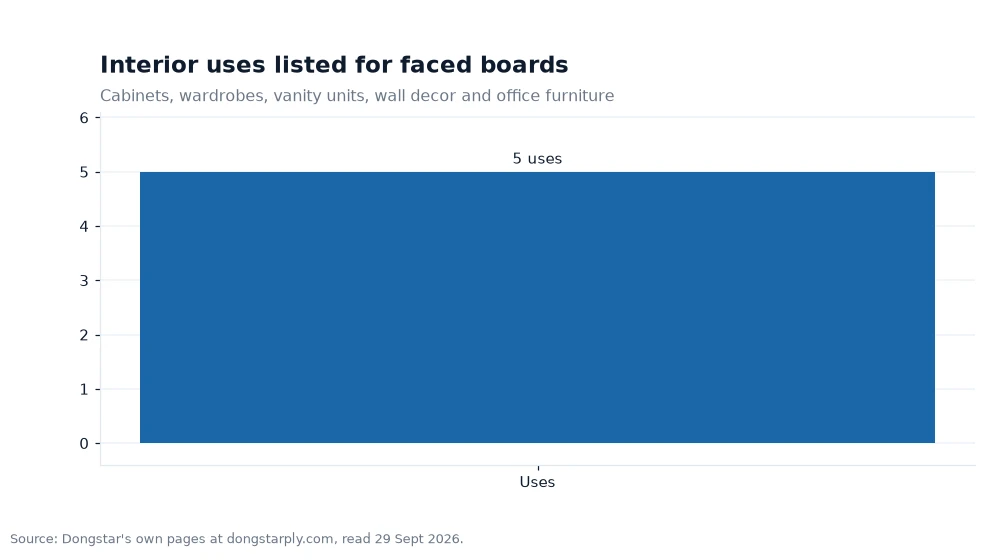
Dongstar lists five uses for faced boards: cabinets, wardrobes, vanity units, wall decor and office furniture. Those five share a set of demands. The surface has to stay clean, resist scratching and moisture, and not fade where daylight falls on it year after year. A vanity unit in a bathroom and a wall panel in a sunlit office look nothing alike, but they ask the same question of the same face.
Edge treatment is the detail that decides how long a faced panel looks new. A panel cut on site exposes the core along the cut line, and in a wet room that exposed edge is where swelling starts. Edge banding in a matching decor, sealed cut edges on shower-adjacent units, and an instruction to cut with a sharp blade and a scoring pass all belong in the same conversation as the thickness choice.
| Field | Published value | What it decides |
|---|---|---|
| Panel size | 1220 × 2440 mm, and more | Cutting yield and door blank count |
| Thickness | 16 mm, 18 mm, and more | Carcase versus door geometry; hinge fixing depth |
| Face type | Synchronized Texture, Glossy, High Glossy, Smooth, Matte, Embossed | Appearance, cleaning, and how marks read in daylight |
| Core type | OSB, MDF, Particle board, Hardwood Plywood | Weight, edge appearance and screw holding |
| Glue and formaldehyde | Urea Formaldehyde; E0, E1 | Moisture durability and indoor-air paperwork |
Worked example: turning a wardrobe run into panels
Take a built-in wardrobe run 3.6 m long and 2.4 m high. The face area is 3.6 m × 2.4 m = 8.64 m² (example). A 1220 × 2440 mm sheet is 2.98 m² of surface, from 1.22 m × 2.44 m (example), so the fronts alone need 8.64 ÷ 2.98 = 2.9 sheets before any cutting loss, which rounds up to four sheets with a working margin (example).
Add two gable ends at 0.6 m × 2.4 m = 1.44 m² each (example), three shelves per bay and the internal partitions, and a 3.6 m run typically lands between eight and eleven sheets depending on the cutting plan. Because the same decor is available on four cores, that plan can be priced two ways: a lighter core for the carcase panels nobody sees, and MDF for the doors where a clean routed edge is part of the design.
Frequently asked questions
Which thickness should a wardrobe carcase use?
The published range starts at 16 mm and 18 mm on a 1220 × 2440 mm sheet. Carcases are normally built from the thinner of the two and doors and drawer fronts from the thicker one, where the extra material supports the hinge and gives fittings a firmer edge to sit in.
Does the core change the formaldehyde class?
No. Glue type and formaldehyde class are published as separate fields. OSB, MDF, particle board and hardwood plywood are core options under the same face, while the urea formaldehyde resin and the E0 or E1 class describe how the panel is bonded and what it emits.
Is a synchronized texture the same as an embossed finish?
They are listed separately. Embossed describes a surface with relief; synchronized texture means that relief is registered to the printed decor, so the grain pattern a buyer sees and the pattern a hand feels are the same pattern.
Where to take the specification next
Two comparison points are worth reading before the cutting plan is fixed: the fibreboard grades listed for painted and routed work, which many furniture makers use as the alternative core, and the chipboard specification used in flat-pack furniture, which follows the same size convention. Specifying a Melamine Board for a cabinet programme then comes down to naming four things in one message: thickness, finish, core and emission class.
Sizes, thicknesses, face types, core options, glue type and formaldehyde classes quoted above are lifted from the manufacturer's site, consulted on 29 Sept 2026, plus taken for this guide, for the numbers in as standard the chart above[1].