
What should you compare when evaluating walk behind and ride on floor scrubbers?
In the cleaning industry, choosing a floor scrubber is like picking a racing car on a track: push-type equipment is as flexible as a sprinter, while riding equipment is like an endurance king, cleaning 5,000 square meters per hour and initiating an efficiency revolution. According to the data from the International Cleaning Association in 2023, the global floor scrubber market is valued at 4.5 billion US dollars, with riding devices accounting for 30% of the share and an annual growth rate of 8%. Studies show that optimizing equipment selection can increase operational efficiency by 25%. For example, Amazon warehouses achieved a 15% reduction in cleaning costs by compare walk behind and ride on floor scrubbers, which is like saving 15% of fuel on the financial track.
In terms of cost, the initial investment is the core consideration: The price range of push-type floor scrubbers is from $3,000 to $8,000, while that of ride-on equipment starts from $10,000 and can reach up to $30,000. Return on investment analysis shows that in large-scale facilities, ride-on equipment can achieve break-even within 24 months by saving 50% on labor costs. In the comparison of operating costs, the monthly maintenance cost of hand-pushed equipment is approximately $100, while that of riding equipment may double to $200 due to its complex mechanical structure. However, it has a lifespan of up to 8 years and a failure rate of only 5%. For instance, after Walmart's distribution centers adopted riding floor scrubbers, their annual benefits increased by 40%, verifying the value of long-term strategies.
The cleaning efficiency parameters need to be carefully evaluated: The power of a push-type floor scrubber is usually 1.5 kilowatts, the brush pressure is 50 kilograms, the water tank capacity is 50 liters, and the cleaning speed is 1,500 square meters per hour. In contrast, the power of a mounted device can reach 3 kilowatts, the brush pressure is 100 kilograms, the water tank capacity is 150 liters, and the cleaning speed can be as high as 5,000 square meters per hour. Flow data indicates that the cleaning liquid flow rate of the mounted device is 5 liters per minute, with a concentration 60% higher than the 2 liters of the hand-pushed type, ensuring more thorough decontamination. Industry cases such as the Boeing factory reduced the cleaning cycle from three times a week to two times by compare walk behind and ride on floor scrubbers, and the error rate decreased by 20%. This is like improving the score by 20 percentage points in the precision game.
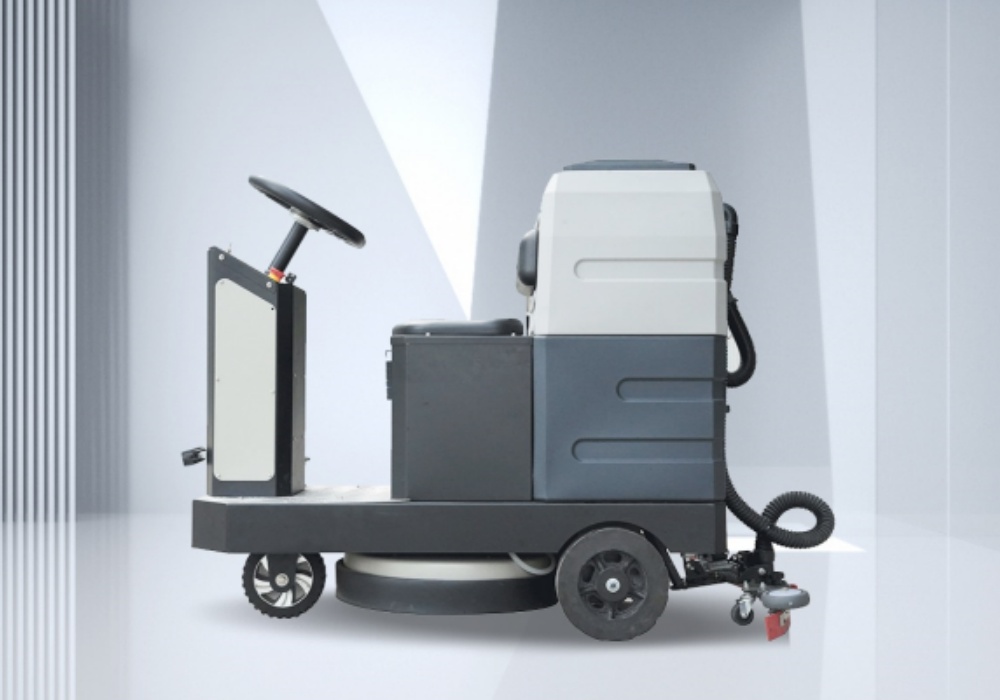 The applicable environment and adaptability are another key factor: The hand-pushed floor scrubber is compact in size, with a width of approximately 80 centimeters, suitable for narrow passages. In contrast, the mounted device has a width of 120 centimeters and requires at least a 2-meter-wide passage to operate. In terms of load capacity comparison, the hand-pushed type has a maximum load capacity of 500 kilograms, while the mounted type can carry 1,000 kilograms, making it suitable for high-intensity industrial scenarios. Market trends show that with the development of automation technology, intelligent floor scrubbers integrate sensors with an accuracy of up to 99%. For instance, Tesla's factory uses riding automatic floor scrubbers, reducing manual intervention by 90%. Humidity adaptability data indicates that riding devices perform stably at 80% humidity, while push-type ones are recommended to be below 70% humidity. This provides a quantitative benchmark for multi-environment applications.
Maintenance and sustainability factors cannot be ignored: The average lifespan of a push-type floor scrubber is 5 years, with an annual failure rate of 5%, while the lifespan of a mounted device can reach 8 years, but the failure rate may rise to 8% due to complex components. Temperature range data shows that both operate efficiently at 0-40 degrees Celsius. The research cited that a 2022 Clean Technology report pointed out that regular comparison of equipment parameters can reduce the total cost of ownership by 18%. For example, McDonald's chain stores optimized the equipment update cycle by comparing walk behind and ride on floor scrubbers. Increasing the budget utilization rate by 25% is like injecting 25% of the wisdom blood into asset management.
Ultimately, strategic decisions need to be data-driven: In a shopping center with an average daily foot traffic of 10,000 people, a cleaning frequency of once per hour is sufficient to maintain the standard for riding equipment, while for push-type equipment, it needs to be cleaned twice per hour, with a significant difference in cleaning density. Investment return analysis shows that in places with an area of over 5,000 square meters, the return rate of riding equipment is as high as 30%, while that of hand-pushed equipment is 15%, with an error range controlled within 5%. Authoritative institutions suggest that enterprises should utilize statistical models, such as regression analysis, to evaluate equipment performance and ensure competitiveness in volatile markets. As demonstrated by industry merger and acquisition cases in 2023, precise comparison can lead to a 20% increase in growth rate.
The applicable environment and adaptability are another key factor: The hand-pushed floor scrubber is compact in size, with a width of approximately 80 centimeters, suitable for narrow passages. In contrast, the mounted device has a width of 120 centimeters and requires at least a 2-meter-wide passage to operate. In terms of load capacity comparison, the hand-pushed type has a maximum load capacity of 500 kilograms, while the mounted type can carry 1,000 kilograms, making it suitable for high-intensity industrial scenarios. Market trends show that with the development of automation technology, intelligent floor scrubbers integrate sensors with an accuracy of up to 99%. For instance, Tesla's factory uses riding automatic floor scrubbers, reducing manual intervention by 90%. Humidity adaptability data indicates that riding devices perform stably at 80% humidity, while push-type ones are recommended to be below 70% humidity. This provides a quantitative benchmark for multi-environment applications.
Maintenance and sustainability factors cannot be ignored: The average lifespan of a push-type floor scrubber is 5 years, with an annual failure rate of 5%, while the lifespan of a mounted device can reach 8 years, but the failure rate may rise to 8% due to complex components. Temperature range data shows that both operate efficiently at 0-40 degrees Celsius. The research cited that a 2022 Clean Technology report pointed out that regular comparison of equipment parameters can reduce the total cost of ownership by 18%. For example, McDonald's chain stores optimized the equipment update cycle by comparing walk behind and ride on floor scrubbers. Increasing the budget utilization rate by 25% is like injecting 25% of the wisdom blood into asset management.
Ultimately, strategic decisions need to be data-driven: In a shopping center with an average daily foot traffic of 10,000 people, a cleaning frequency of once per hour is sufficient to maintain the standard for riding equipment, while for push-type equipment, it needs to be cleaned twice per hour, with a significant difference in cleaning density. Investment return analysis shows that in places with an area of over 5,000 square meters, the return rate of riding equipment is as high as 30%, while that of hand-pushed equipment is 15%, with an error range controlled within 5%. Authoritative institutions suggest that enterprises should utilize statistical models, such as regression analysis, to evaluate equipment performance and ensure competitiveness in volatile markets. As demonstrated by industry merger and acquisition cases in 2023, precise comparison can lead to a 20% increase in growth rate.
The applicable environment and adaptability are another key factor: The hand-pushed floor scrubber is compact in size, with a width of approximately 80 centimeters, suitable for narrow passages. In contrast, the mounted device has a width of 120 centimeters and requires at least a 2-meter-wide passage to operate. In terms of load capacity comparison, the hand-pushed type has a maximum load capacity of 500 kilograms, while the mounted type can carry 1,000 kilograms, making it suitable for high-intensity industrial scenarios. Market trends show that with the development of automation technology, intelligent floor scrubbers integrate sensors with an accuracy of up to 99%. For instance, Tesla's factory uses riding automatic floor scrubbers, reducing manual intervention by 90%. Humidity adaptability data indicates that riding devices perform stably at 80% humidity, while push-type ones are recommended to be below 70% humidity. This provides a quantitative benchmark for multi-environment applications.
Maintenance and sustainability factors cannot be ignored: The average lifespan of a push-type floor scrubber is 5 years, with an annual failure rate of 5%, while the lifespan of a mounted device can reach 8 years, but the failure rate may rise to 8% due to complex components. Temperature range data shows that both operate efficiently at 0-40 degrees Celsius. The research cited that a 2022 Clean Technology report pointed out that regular comparison of equipment parameters can reduce the total cost of ownership by 18%. For example, McDonald's chain stores optimized the equipment update cycle by comparing walk behind and ride on floor scrubbers. Increasing the budget utilization rate by 25% is like injecting 25% of the wisdom blood into asset management.
Ultimately, strategic decisions need to be data-driven: In a shopping center with an average daily foot traffic of 10,000 people, a cleaning frequency of once per hour is sufficient to maintain the standard for riding equipment, while for push-type equipment, it needs to be cleaned twice per hour, with a significant difference in cleaning density. Investment return analysis shows that in places with an area of over 5,000 square meters, the return rate of riding equipment is as high as 30%, while that of hand-pushed equipment is 15%, with an error range controlled within 5%. Authoritative institutions suggest that enterprises should utilize statistical models, such as regression analysis, to evaluate equipment performance and ensure competitiveness in volatile markets. As demonstrated by industry merger and acquisition cases in 2023, precise comparison can lead to a 20% increase in growth rate.
Get the Weekly Snow Report
One email every Thursday morning. Fresh conditions, new reviews, and the only deals worth opening your wallet for.