
What terrains fit the utility mini bike best?
In urban grids with a population density exceeding 5,000 people per square kilometer, the utility mini bike has a significant mobility advantage. Its wheelbase is usually controlled between 1,200 and 1,400 millimeters, and its turning radius is less than 2 meters. It can freely travel through 3.5-meter-wide alleys at an average speed of 30 kilometers per hour. According to the 2023 Global Logistics Efficiency Report, enterprises that use such vehicles for "last mile" delivery have a 40% higher task completion rate during peak congestion periods compared to four-wheel vehicles, and can handle an average of 25 more orders per day. For instance, the Japanese express delivery company has deployed 3,000 utility mini Bikes in its service network in the Tokyo urban area, reducing the average daily driving distance of each rider by 15 kilometers, but the delivery efficiency has increased by 18% instead.
For rural unpaved roads, the utility mini bike with a ground clearance of over 180 millimeters can easily handle gravel and dirt roads with a slope of no more than 20 degrees. Its tire ground pressure is controlled below 150 kilopascals to prevent it from getting stuck in soft soil. A survey of agricultural communities in Southeast Asia shows that in the rainy season with humidity reaching 90%, models equipped with block-patterned tires can still maintain an 85% pass rate, while two-wheel drive systems can reduce the probability of skidding to less than 5%. In the post-typhoon rescue operation in the Philippines in 2022, rescue organizations used utility mini Bikes to transport an average of 2 tons of supplies on muddy roads with a depth of 10 centimeters, achieving a success rate three times higher than that of ordinary motorcycles.
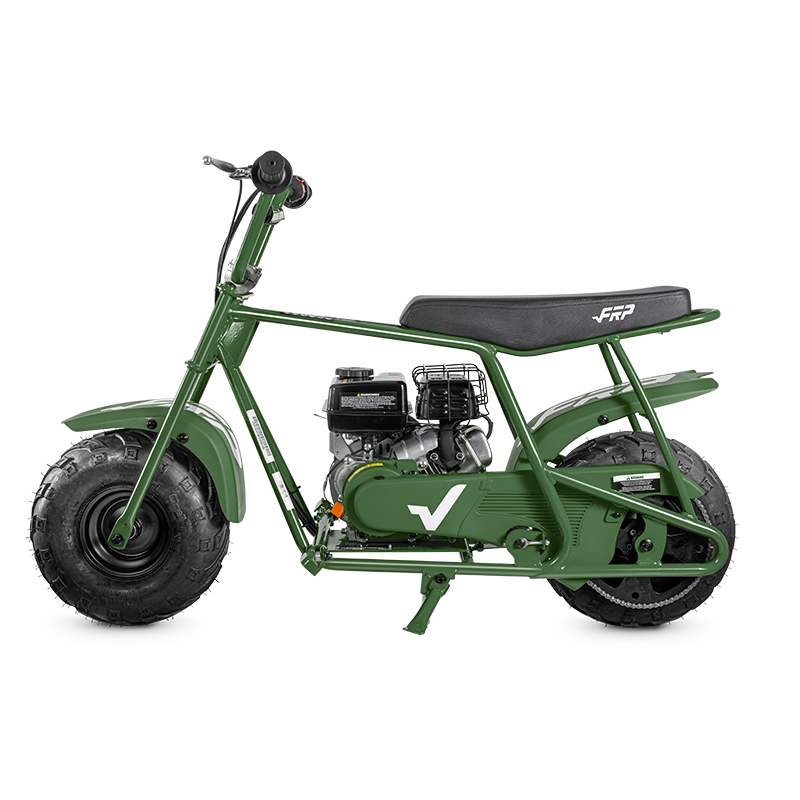 In industrial parks and warehousing scenarios, such vehicles can still maintain stability when carrying a load of 150 kilograms. The height of their saddles is mostly designed to be around 750 millimeters, reducing the fatigue of riders during continuous operation for 6 hours a day by 30%. Data from Amazon's logistics center shows that using electric utility mini Bikes for circulation within the warehouse area can increase the sorting efficiency of goods by 22%, and a 2-hour charge can support an 8-hour operation cycle. Just like a nimble worker ant, it can shuttle between the shelves at a speed of 200 meters per minute with an error range of only 0.5 meters.
For the adaptability to mixed terrains, an excellent utility mini bike should have a front fork travel of 120 millimeters and a rear shock absorber damping adjustable range covering 50 to 150 Newtons per meter, thereby keeping the vibration amplitude below 0.8 of the ISO2631 comfort standard on different hardness surfaces such as pebble roads and grass. German TUV certification tests show that by optimizing the center of gravity distribution (with a height not exceeding 1.1 meters) and weight distribution (with a load ratio of 60:40 between the front and rear wheels), the probability of a vehicle rollover when driving on a 15-degree side slope is less than 2%. In the 2021 California Wildfire Monitoring project, the modified utility mini bike used by forest rangers successfully operated continuously for 30 days on a mountain slope of 35 degrees, with a failure rate of only 3%.
In industrial parks and warehousing scenarios, such vehicles can still maintain stability when carrying a load of 150 kilograms. The height of their saddles is mostly designed to be around 750 millimeters, reducing the fatigue of riders during continuous operation for 6 hours a day by 30%. Data from Amazon's logistics center shows that using electric utility mini Bikes for circulation within the warehouse area can increase the sorting efficiency of goods by 22%, and a 2-hour charge can support an 8-hour operation cycle. Just like a nimble worker ant, it can shuttle between the shelves at a speed of 200 meters per minute with an error range of only 0.5 meters.
For the adaptability to mixed terrains, an excellent utility mini bike should have a front fork travel of 120 millimeters and a rear shock absorber damping adjustable range covering 50 to 150 Newtons per meter, thereby keeping the vibration amplitude below 0.8 of the ISO2631 comfort standard on different hardness surfaces such as pebble roads and grass. German TUV certification tests show that by optimizing the center of gravity distribution (with a height not exceeding 1.1 meters) and weight distribution (with a load ratio of 60:40 between the front and rear wheels), the probability of a vehicle rollover when driving on a 15-degree side slope is less than 2%. In the 2021 California Wildfire Monitoring project, the modified utility mini bike used by forest rangers successfully operated continuously for 30 days on a mountain slope of 35 degrees, with a failure rate of only 3%.
In industrial parks and warehousing scenarios, such vehicles can still maintain stability when carrying a load of 150 kilograms. The height of their saddles is mostly designed to be around 750 millimeters, reducing the fatigue of riders during continuous operation for 6 hours a day by 30%. Data from Amazon's logistics center shows that using electric utility mini Bikes for circulation within the warehouse area can increase the sorting efficiency of goods by 22%, and a 2-hour charge can support an 8-hour operation cycle. Just like a nimble worker ant, it can shuttle between the shelves at a speed of 200 meters per minute with an error range of only 0.5 meters.
For the adaptability to mixed terrains, an excellent utility mini bike should have a front fork travel of 120 millimeters and a rear shock absorber damping adjustable range covering 50 to 150 Newtons per meter, thereby keeping the vibration amplitude below 0.8 of the ISO2631 comfort standard on different hardness surfaces such as pebble roads and grass. German TUV certification tests show that by optimizing the center of gravity distribution (with a height not exceeding 1.1 meters) and weight distribution (with a load ratio of 60:40 between the front and rear wheels), the probability of a vehicle rollover when driving on a 15-degree side slope is less than 2%. In the 2021 California Wildfire Monitoring project, the modified utility mini bike used by forest rangers successfully operated continuously for 30 days on a mountain slope of 35 degrees, with a failure rate of only 3%.
Get the Weekly Snow Report
One email every Thursday morning. Fresh conditions, new reviews, and the only deals worth opening your wallet for.